
English Speaking Exercises
Speaking improves through active use, not passive study. This page brings together practical English speaking exercises for questions, descriptions, role-play, storytelling, opinions, pronunciation and conversation, so you can turn speaking practice into real English fluency and confidence.
What Are English Speaking Exercises?
English speaking exercises are structured activities designed to encourage learners to actively produce spoken English, rather than simply reading or listening. Different exercises build different abilities: vocabulary retrieval, sentence formation, pronunciation, answering questions, describing information, storytelling, expressing opinions, managing a conversation, fluency and confidence. Working through a mix of exercises regularly gives you well-rounded, practical speaking practice.
Structured Practice
A specific task gives you a clear speaking goal, so each exercise has a purpose rather than open-ended, unfocused talking.
Active Vocabulary
Speaking exercises push you to actually use vocabulary in sentences, rather than just recognising words when you read or hear them.
Longer Answers
Exercises encourage you to expand short answers into fuller explanations, adding detail, reasons and examples as you speak.
Real Communication
Practical exercises simulate the kinds of conversations you meet outside the classroom, from everyday chat to work discussions.
10 English Speaking Exercises
These ten exercises cover the core speaking skills most learners need: answering, describing, narrating, arguing, comparing and reacting in real time. Work through them regularly, alone or with a tutor, to build a well-rounded speaking routine.
1
Question And Answer
Answer an open-ended English question using at least several complete sentences, adding reasons or examples where you can.
2
Describe A Picture
Describe what you can see, where things are positioned and what might be happening in the scene.
3
Tell A Story
Describe an event from beginning to end, using sequence language like first, then, after that and finally.
4
Give Your Opinion
State an opinion on a familiar topic and explain your reasons clearly.
5
Compare Two Things
Compare two places, products, experiences, people or ideas, describing similarities and differences.
6
One-Minute Speaking
Choose a topic and speak continuously about it for approximately one minute without stopping.
7
Role-Play
Practise a realistic conversation such as ordering food, making an appointment or speaking with a colleague.
8
Explain How Something Works
Explain a process, routine or familiar activity step by step, in a logical order.
9
Retell Something
Listen to or read short information, then explain it again afterwards using your own words.
10
Follow-Up Questions
Answer a question and then continue the conversation by responding naturally to follow-up questions.
English Speaking Exercises For Beginners
These beginner-friendly exercises use accessible, everyday language so you can build confidence with short, simple answers before moving on to longer, more detailed speaking.
Introduce Yourself
Practise saying your name, country, work, studies and interests in a few simple sentences.
Talk About Your Day
Describe simple daily activities, such as what you did this morning or after work.
Describe Your Family
Practise basic descriptions of family members, their names, ages and what they do.
Talk About Your Hobbies
Explain what you enjoy doing in your free time and why you enjoy it.
Answer Simple Questions
Practise answering everyday questions about routines, preferences and daily life.
English Speaking Exercises For Intermediate Learners
At intermediate level, exercises shift toward explaining, comparing and discussing, helping you connect ideas and give more complete, reasoned answers.
Explain Your Opinion
Give an opinion on a familiar topic and support it with clear reasons.
Discuss A Problem
Describe a problem you have experienced and suggest possible solutions.
Compare Options
Explain the advantages and disadvantages of two or more different choices.
Tell A Personal Story
Describe a personal experience, adding relevant detail and context.
Discuss A Current Topic
Discuss a general topic of your choice while practising vocabulary and follow-up questions.
Advanced English Speaking Exercises
Advanced exercises focus on sophisticated communication rather than simply difficult vocabulary, building your ability to argue, analyse and lead a conversation with precision.
Defend An Opinion
Present an argument clearly and respond to alternative viewpoints.
Explain A Complex Idea
Explain an abstract or professional topic clearly, in a way a listener can follow.
Debate A Topic
Present arguments for and against an issue in a structured way.
Analyse A Situation
Explain the causes, consequences and possible solutions to a given situation.
Lead A Discussion
Ask questions, respond to ideas and keep a discussion moving naturally.
English Conversation Exercises
These exercises focus on the mechanics of conversation itself, the small moves that keep a natural exchange flowing from start to finish.
Greeting And Small Talk
Practise starting natural conversations with a friendly greeting and light small talk.
Asking Follow-Up Questions
Learn to keep a conversation going by asking relevant follow-up questions.
Agreeing And Disagreeing
Practise expressing agreement and disagreement politely and clearly.
Asking For Clarification
Practise what to say when you do not understand something someone has said.
Changing The Topic
Practise moving naturally from one subject to another during a conversation.
Ending A Conversation
Practise polite, natural ways to finish a conversation.
Speaking Exercises For Fluency
Fluency practice can involve reducing long pauses, connecting ideas more smoothly and producing language more naturally, without aiming for perfect accuracy on every sentence.
Timed Speaking
Speak about a chosen topic for a set period, without stopping to correct yourself.
Sentence Expansion
Start with a short sentence and gradually add more information to extend it.
Follow-Up Chain
Answer a question and continue responding to a chain of additional questions.
Topic Switching
Move between related topics while continuing to speak, without losing your flow.
English Speaking Exercises At Home
You do not need a partner for every exercise. These practice techniques help you build speaking habits at home between lessons, though they work best alongside real conversation with a tutor.
Mirror Speaking
Speak aloud in front of a mirror while practising introductions or explanations.
Object Description
Choose an object nearby and describe its appearance, purpose and features.
Daily Diary
Describe out loud what happened during your day, as if telling a friend.
Voice Recording
Record yourself speaking and listen again afterwards to identify areas to improve.
Question Practice
Choose several speaking questions and answer them aloud, one after another.
Practise Speaking With A Tutor
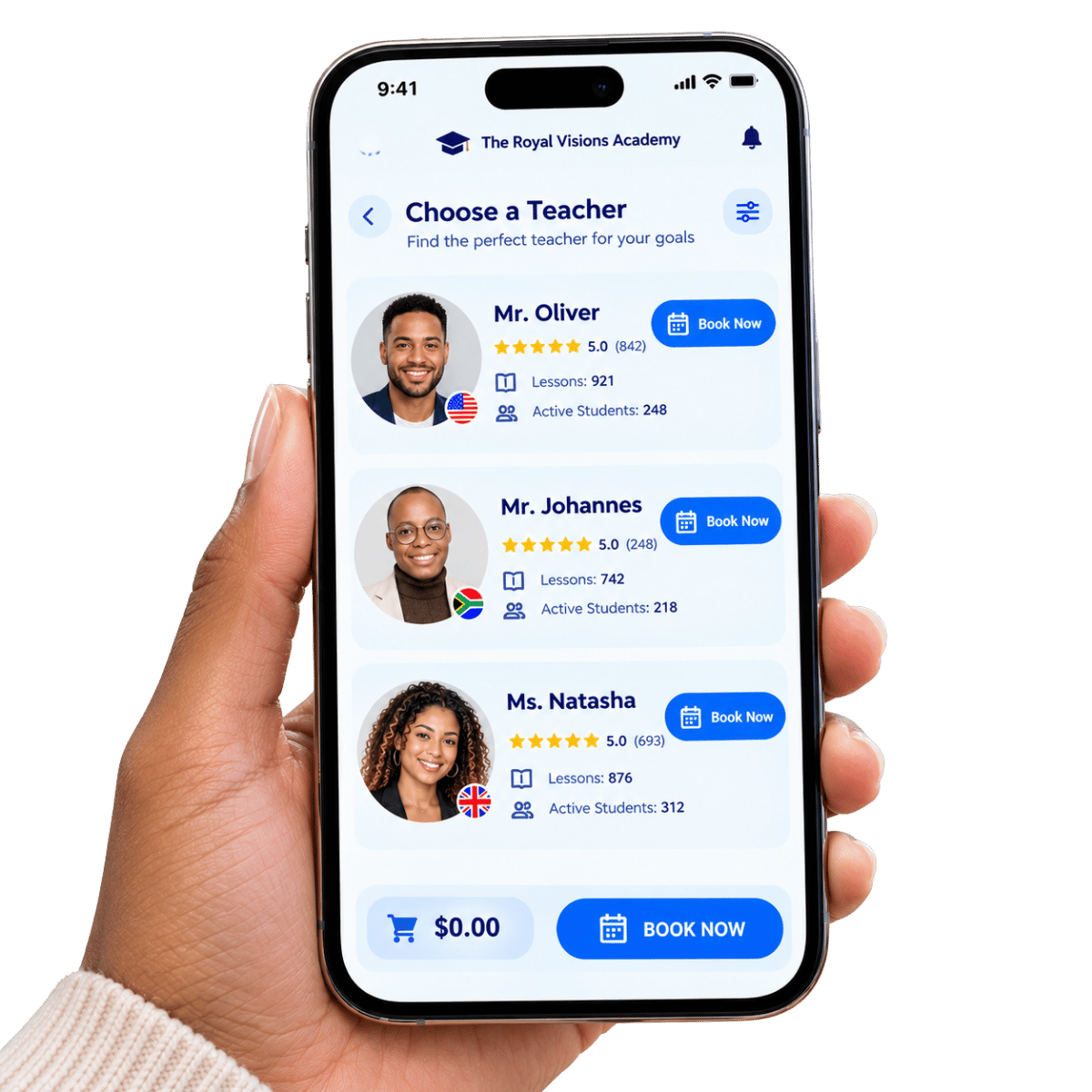
A live teacher can turn any exercise into real, interactive communication: asking follow-up questions, setting up role-play, correcting mistakes, giving pronunciation feedback, suggesting vocabulary, and pushing you toward longer answers in realistic situations.
Meet Our English Tutors

Mr. Johannes
English Teacher
Focuses on practical speaking exercises, guiding students through real conversation practice to build active, confident communication skills.

Ms. Colette
English Teacher
Builds lessons around speaking activities and conversation practice, helping students turn exercises into natural, practical communication.

Ms. Shirley
English Teacher
Focuses on conversation and speaking confidence, using practical English exercises tailored to each student’s current level.

Ms. Lessy
English Teacher
Combines vocabulary building with speaking exercises, helping students communicate more naturally in everyday English situations.
Create A Speaking Practice Routine
Repetition is a practice technique, not a guaranteed path to fluency on its own, but a simple routine like this gives your practice structure and direction.
1
Choose A Topic
Select something familiar or useful to you right now.
2
Choose An Exercise
Pick a question, description, role-play or storytelling task from this page.
3
Speak
Complete the exercise aloud, without stopping to perfect every sentence.
4
Review
Identify vocabulary, grammar or pronunciation areas you could improve.
5
Repeat
Complete the same exercise again, applying what you noticed the first time.
Choose Your Speaking Exercise
Different goals call for different exercises. Use this overview to find the type of speaking practice most relevant to what you need right now.
Vocabulary Practice
Exercises that push you to actively use new words in full sentences, not just recognise them.
Fluency Practice
Exercises that build smoother, more natural speech with fewer long pauses.
Pronunciation Practice
Exercises that focus on clear sounds, stress and rhythm as you speak.
Conversation Practice
Exercises that build the back-and-forth skills of a real, natural conversation.
Interview Practice
Exercises that prepare you to answer questions clearly and confidently under pressure.
Business Speaking
Exercises focused on clear, professional communication for work situations.
Travel Speaking
Exercises for the practical English used at airports, hotels and while travelling.
Everyday English
Exercises for the day-to-day English used in shops, appointments and casual chat.
Presentation Practice
Exercises that build the skills to explain ideas clearly to a group or audience.
Opinion Practice
Exercises that help you state and support opinions clearly and confidently.
Continue Practising Your English
Continue practising with our English speaking practice, English conversation practice and English pronunciation practice. You can also explore our English grammar lessons, Business English lessons and English courses, or book a free English lesson to get started.
English Speaking Exercises FAQ
What are good English speaking exercises?
Good exercises give you a clear, specific speaking task, such as answering a question, describing something or telling a short story, rather than open-ended, unstructured talking.
How can I practise speaking English at home?
You can practise at home with mirror speaking, object description, a spoken daily diary, voice recording or working through a list of speaking questions aloud.
Which exercises improve English speaking?
A mix of question-and-answer, storytelling, opinion, comparison and role-play exercises builds different speaking skills, from vocabulary retrieval to fluency and confidence.
How can I improve my English speaking fluency?
Fluency exercises like timed speaking, sentence expansion and topic switching can help you connect ideas more smoothly, alongside regular conversation practice with a tutor.
What speaking exercises can beginners practise?
Beginners can start with simple exercises such as introducing themselves, describing their family or talking about their daily routine using short, familiar sentences.
How often should I practise English speaking exercises?
Short, regular practice, ideally most days of the week, tends to be more effective than occasional long sessions.
Can I practise English speaking exercises online?
Yes, many of these exercises can be practised on your own, and you can also practise them live online with a private English tutor.
What exercises help with English conversation?
Exercises focused on greetings, follow-up questions, agreeing and disagreeing, and asking for clarification all build practical conversation skills.
How can I practise English speaking by myself?
You can practise alone using mirror speaking, voice recordings, describing objects around you or answering a list of speaking questions out loud.
Can an English tutor help me practise speaking exercises?
Yes, a tutor can turn any exercise into an interactive conversation, offering follow-up questions, corrections and pronunciation feedback as you speak.
Book Your Free English Lesson
Try a practical speaking lesson and talk through your English goals with a private tutor, one-to-one.
Put Your English Into Practice
Reading about English is not the same as speaking it. Use these speaking exercises regularly, and combine them with real English speaking practice and English conversation exercises with a tutor, to actively communicate rather than simply study.