
TOEFL vocabulary practice online
Vocabulary for TOEFL
Build the everyday and academic vocabulary you need for all four TOEFL sections. Learn words in context, practise using them and choose a course to grow your vocabulary today.
Choose your focus:

Courses to build your vocabulary
Choose Your Goal. Find Your Course.
Build the vocabulary, grammar and speaking skills that make every TOEFL section easier. Pick a category and start learning today.
Turn Your Practice Into a Certificate
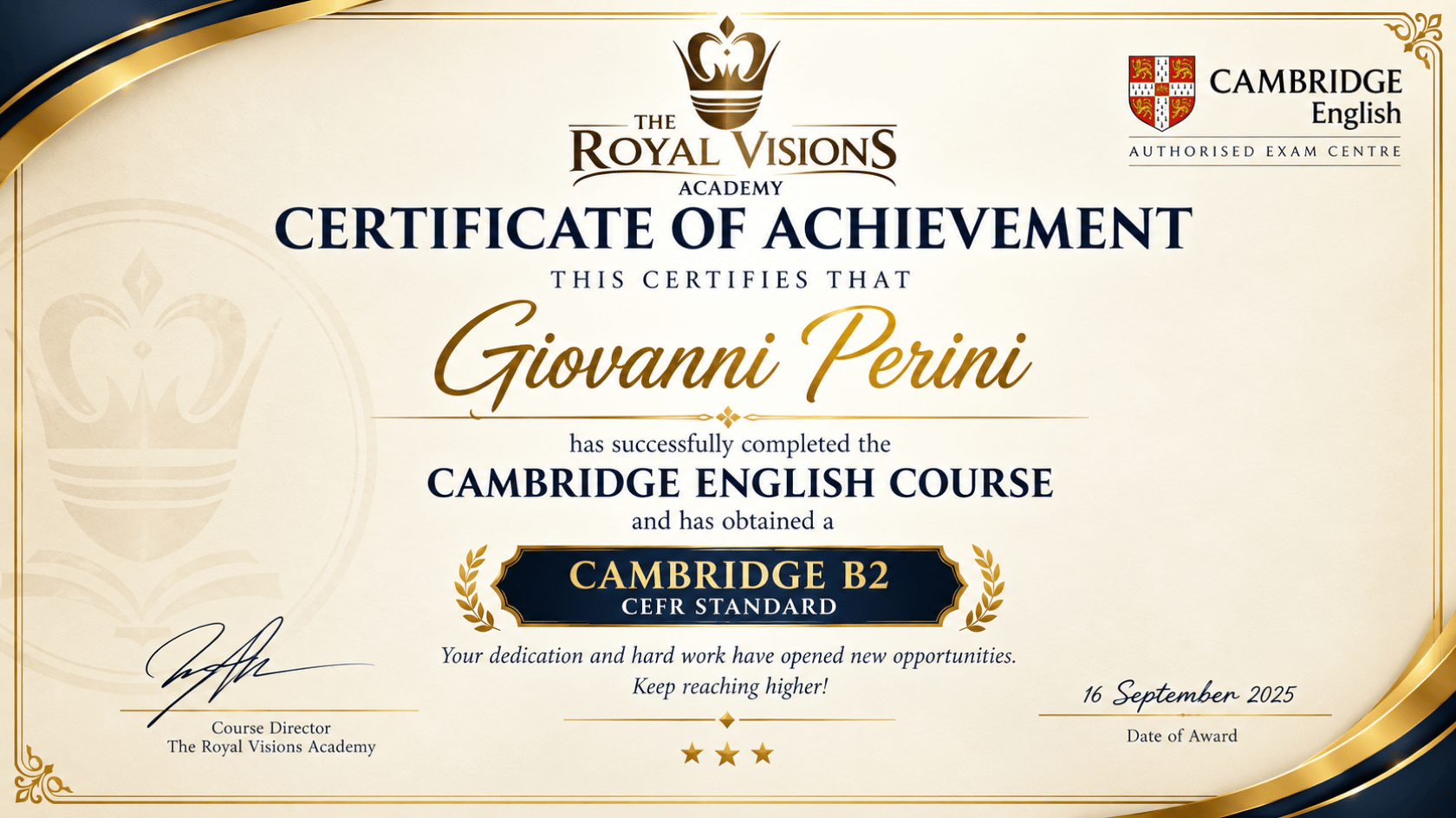
Complete your English courses and show your progress with a certificate of completion from The Royal Visions Academy. It is a great way to stay motivated while you grow your vocabulary.
- Show your progress in vocabulary and language
- Stay motivated with a clear finish line
- Add your achievement to your CV or LinkedIn profile
- Learn at your own pace, on any device
Certificate availability depends on the course. A completion certificate is not an official TOEFL score or an ETS certificate.
Your vocabulary journey
From Memorising to Really Using Words
Four habits that turn new words into words you can use with confidence.
Learn in Context
Study each new word inside a real sentence.
Use It Yourself
Use new words in your own speaking and writing.
Review Regularly
Revisit your words after one day, one week and one month.
Build Word Families
Learn the noun, verb and adjective forms together.
Popular skills
Skills That Build a Stronger Vocabulary
Practise the skills that help you learn words faster and remember them longer.
Quick answers
Vocabulary for TOEFL: Frequently Asked Questions
What is vocabulary for TOEFL?
Vocabulary for TOEFL means the everyday and academic words and phrases you need to understand and use across the test. Strong vocabulary helps you read texts, follow spoken English, speak clearly and write precisely.
Book a Free LessonIs there a separate vocabulary section on the TOEFL?
No. There is no separate vocabulary section. Vocabulary matters in all four sections: Reading, Listening, Speaking and Writing. The more words you know and can use well, the easier each section becomes.
Book a Free LessonDoes ETS publish an official TOEFL word list?
ETS does not publish a fixed list of words to learn. Many learners use general academic and everyday word lists as study tools. Check the official ETS website for its latest preparation resources.
Book a Free LessonHow many words do I need to know?
There is no fixed number. Focus on the words you meet most often and learn them well. Knowing how to use a smaller set of words correctly is better than half-remembering a very long list.
Book a Free LessonWhich words should I learn first?
Start with common everyday words, then add frequent academic words connected to themes such as education, science, society, business, health, technology and the environment. These themes appear often in academic English.
Book a Free LessonWhat is the Academic Word List?
The Academic Word List is a well-known list of 570 word families that appear often in academic texts, created by Averil Coxhead in 2000. It is a useful study tool for university English, but it is not an official TOEFL list.
Book a Free LessonHow does vocabulary help in TOEFL Reading?
A wide vocabulary helps you understand texts faster and work out new words from context. The current Reading section also includes Complete the Words, which tests your spelling and knowledge of word forms, so learning how words change is important.
Book a Free LessonHow does vocabulary help in TOEFL Listening?
You need to recognise words when you hear them at natural speed, including their stress and pronunciation. Learning how a word sounds, not only how it looks, makes it much easier to understand in conversations, announcements and talks.
Book a Free LessonHow does vocabulary help in Speaking and Writing?
Precise words help you explain your ideas clearly and avoid repeating the same word. Learn common word combinations, such as make a decision or play a role, so your speaking and writing sound natural.
Book a Free LessonWhat is the best way to learn new words?
Learn each word in a full sentence, use it in your own speaking or writing the same day, and review it regularly. Keep a vocabulary notebook with the meaning, an example sentence and related forms of the word.
Book a Free LessonHow many new words should I learn each day?
A realistic goal is about five to ten words a day that you really practise and review. Quality matters more than speed, so make time to revisit older words as well as learning new ones.
Book a Free LessonWhat is a word family and why should I learn it?
A word family groups related forms of a word, such as analyse, analysis, analytical and analytically. Learning the family helps you choose the right form in a sentence, which supports reading, writing and the Complete the Words task.
Book a Free LessonHow can I remember words for a long time?
Review words after one day, one week and one month. Say them aloud, write your own example sentences and connect each word to something personal. Flashcards and short daily reviews work well.
Book a Free LessonShould I memorise word lists without context?
It is better not to. A list can be a starting point, but you remember words best when you see them in sentences, learn their common partners and use them yourself.
Book a Free LessonCan The Royal Visions Academy help me build vocabulary?
Yes. You can take our English courses at your own pace to build vocabulary, grammar and speaking skills, and several are free. You can also book a free live lesson with a tutor to practise using new words. Our courses build general English skills and are not official TOEFL materials.
Book a Free LessonTOEFL is a registered trademark of Educational Testing Service (ETS). The Royal Visions Academy is not affiliated with or endorsed by ETS. Word lists such as the Academic Word List are study tools and are not official TOEFL lists. Please check the official ETS website for the latest test format and preparation resources.